Choosing a Vintage-Style Wall Clock for the Room You Have
Work from sight lines, face size and wall projection when selecting round, station-style or maritime wall clocks.
Choose a wall-clock format by the directions from which people approach it, including projection, access and readable face size.
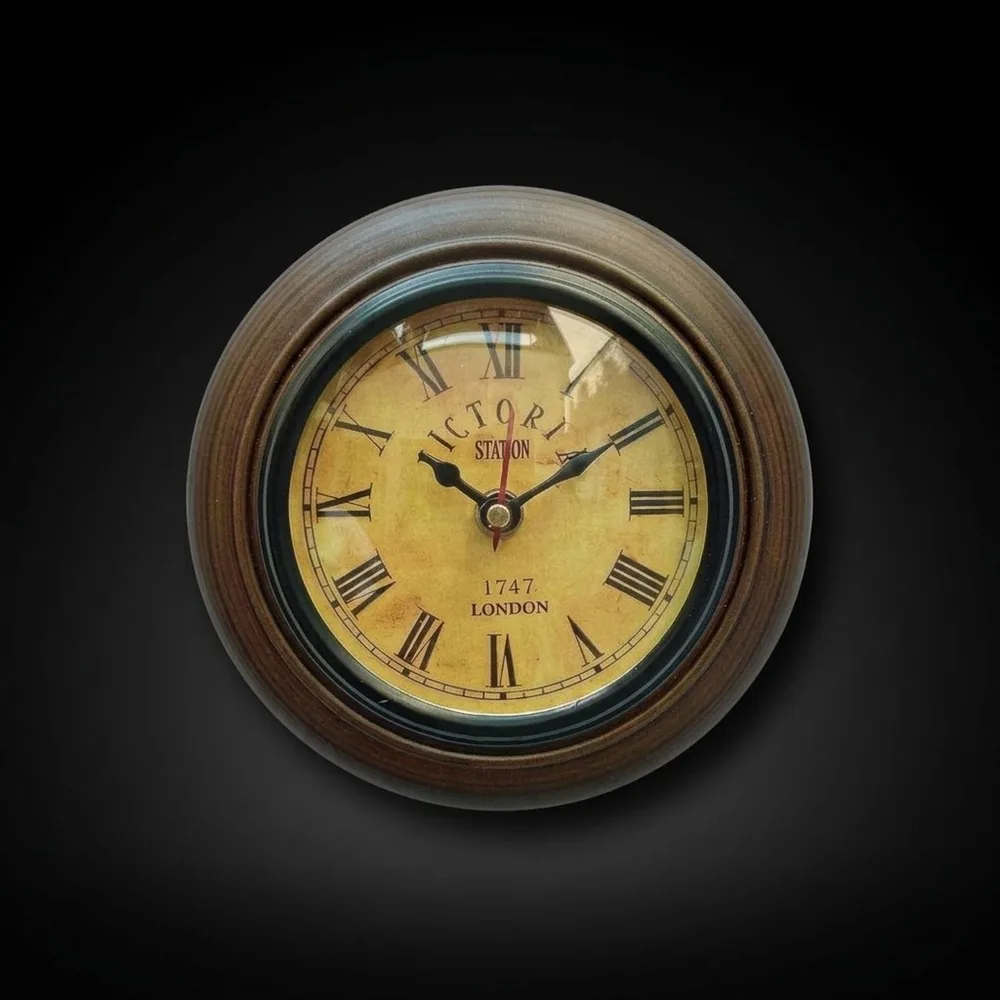
The difference between a single-face and double-sided wall clock is primarily about direction. A single face is read by looking toward a wall. A double-sided form usually projects into the room so its faces can be seen from opposite approaches. The second arrangement can solve a visibility problem, but it also creates a mounting and clearance problem that must be considered.
Do not choose a double-sided model simply because it appears more substantial in a photograph. Draw the paths people take through the room, then ask which faces would actually be visible. If one side would face into a bookcase, the extra dial may contribute little.
A flat clock can be an effective choice for a room in which the main seats face one wall. Mark a temporary circle at the proposed position and check it from the desk, sofa and entrance. Look for an open door, lamp or tall furniture that could hide it.
A projecting clock is more promising where people move parallel to the wall, such as along a corridor. Check both approaches. A bracket should place the faces where they can be read without creating a collision point. The useful projection is a room measurement, not a styling detail.
| Decision | Single-face clock | Double-sided clock |
|---|---|---|
| Primary view | Toward the mounting wall | Along opposing directions beside the wall |
| Space occupied | Mostly the wall plane | Wall plane plus bracket projection |
| Mounting question | Weight and fixing points | Weight, projection and leverage |
| Maintenance question | Access behind the body | Access to both faces and their controls |
| Styling role | Wall composition | A stronger directional object in the room |
Neither column establishes safe installation. Request the chosen model’s weight and instructions, and have hardware selected for the actual wall. A projecting object is especially worth checking in places where people carry bags or cleaning equipment.
Antiqula’s dial-x-8-1 is listed as a dual-sided Victorian-style clock with an overall height including its support. That measurement should not be mistaken for the diameter of either face. Ask for separate dimensions if the listing does not supply them.
The single-face dial-x-6-0 is a compact wooden round. Its smaller overall form may suit a tight wall area, but readability still needs to be tested at the expected distance. A larger decorative surround does not always mean a larger readable dial. Consider contrast and reflections as well as size.
Ask whether the two displays use separate movements or another arrangement, how the time is set and how power is accessed. Do not infer the answer from the number of faces. If two settings need routine attention, keep that in the maintenance note for staff.
For a public interior, consider whether both sides need to show the same time and who checks them. The idea of a station-style clock is useful visually, but it does not make the reproduction a synchronised commercial timing system. Keep the function described at the level established for the model.
Use a flat round when the main view is direct and the available wall area is clear. Consider a double-sided design when the two approach directions genuinely benefit from it and the projection can be accommodated. If the room sketch leaves uncertainty, make a full-size temporary mock-up before ordering.
A clock is successful when a person can glance at it naturally. The best format supports that glance, remains accessible for maintenance and has an appropriate fixing arrangement. The decorative theme can then add character without dictating a poor placement.
Catalogue reference: DialX 6.0. Listed material: Wood.
Check the current product page and ask for model-specific dimensions, packaging and suitability before ordering.
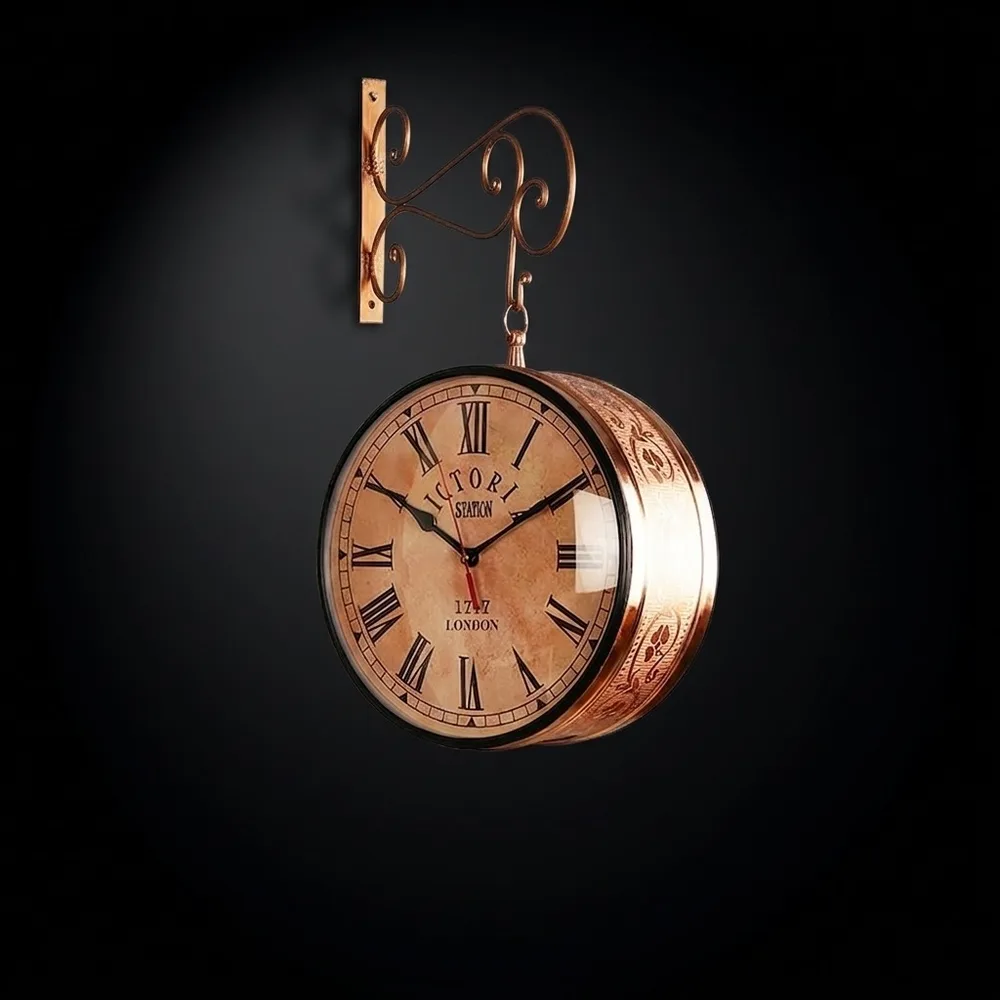
Catalogue reference: DialX 10.2. Listed material: Copper / Gold Finish Metal.
Check the current product page and ask for model-specific dimensions, packaging and suitability before ordering.
Explore Antiqula’s wall clocks catalogue
Catalogue examples were checked against Antiqula’s product records on 2026-10-02. Research sources provide context; they do not certify the performance of individual catalogue products.